
Change.GOV switches to Creative Commons

Maybe the new president will bring some change to our copyright laws.  It seems the first step was taken today as CHANGE.GOV’s copyright designation was changed from “all rights reserved” to Creative Commons Attribution license.
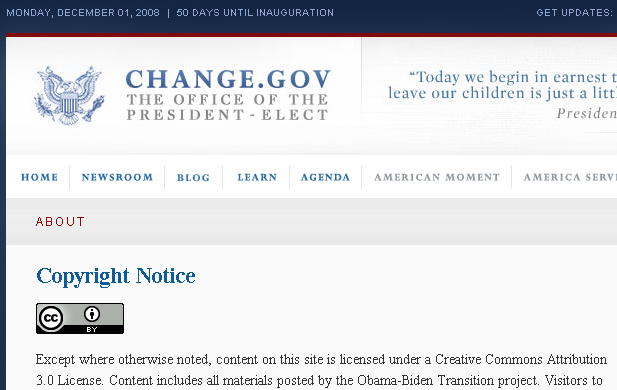
It is a well known fact that Lawence Lessig is a supporter of Obama.  Maybe Lessig has some influence on the new President.

Works licensed under Creative Commons are more restricted than works in the public domain.  There is some debate as to whether everything on CHANGE.GOV is by definition already in the public domain.  By definition, works created by the federal government or agents of the federal government are automatically in the public domain.  Obama is not officially the President, but all his content is on a site using a dot GOV domain.  I tell my students that dot GOV web sites are federal government projects.  That makes them in the public domain.

I still think the Creative Commons designation is OK on the site.  There are areas of the site which seek input from the general public.  If someone who is not employed by the federal government were to post a significant creative work in a “comment” area, that post would be licensed under the Creative Commons Attribution license.

Our copyright law definitely needs some change.  Since 1998, no copyright protected work has gone into the public domain.  We have ten more years before the Mickey Mouse Copyright Extension Act expires.  Hopefully, CHANGE.GOV will do more than add a Creative Commons logo to the site.

This entry was posted in edtech. Bookmark the permalink.

4 Responses to Change.GOV switches to Creative Commons

  1. That’s an interesting question. I’m pretty sure the president-elect is not currently a government employee. He has already resigned from the Senate, and, while it’s clear that the federal government has the intention of employing him, that hasn’t started yet. So I’m not sure the work created by Mr. Obama would be automatically in the public domain.

    I’m not sure about the transition team. I don’t know enough about the process to understand if they’re government employees or not. If they are, their work would probably be in the public domain.

    It is interesting to note that, while he does have a .GOV domain name, his site isn’t hosted in a federal government address space. A quick DNS lookup shows that “change.gov” points to 69.25.74.162, which is owned by a hosting company (Internap). That’s very different, from, say, “senate.gov” which uses 156.33.195.33 and is clearly in the class C network owned by the United States Senate. Would the fact that this site is not hosted by the U.S. Government change anything from a copyright perspective?

    I agree that it’s good news that they’re using a CC license, just to open it up and remove some of the ambiguity of the copyright status. And it does — at least — show that someone in the Obama camp knows what CC is.

  2. Alvin Trusty says:

    I found this at http://www.dotgov.gov/help_qualify.aspx

    — – — – — – — – — – — – — –

    Registrations that qualify for a .gov domain

    * U.S. Governmental departments, programs, and agencies on the federal level
    * Federally recognized Indian Tribes (-NSN.gov domain)
    * State governmental entities/programs
    * Cities and townships represented by an elected body of officials
    * Counties and parishes represented by an elected body of officials
    * U.S. territories

    — – — – — – — – — – — – — –

    By process of elimination, CHANGE.GOV would have to fall under that first category. The site is some sort of program at the federal level. As a federal program, it should be in the public domain.

  3. Agreed.

    That’s actually an interesting list. I was under the impression that use of .GOV was now limited to federal programs and entities, and that the use for state/local governments was now depreciated. I thought “ohio.gov” was the exception, rather than the rule.

    It’s kind of like the “.EDU” top-level domain. It used to be the case that any educational institution could get one, but it was eventually limited to higher ed. There are a few K-12 school districts (like hudson.edu) that registered EDU domains early enough that they got to keep them when the rules changed.

  4. itechnology says:

    Cool Stuff

    All the steps are clearly mentioned.

    Thanks