Vistativo

I have had a TV tuner card for many years.   I have used it as a streaming TV server that I created using the tuner card and Microsoft Media Encoder.  The TV signal comes into the computer with the tuner and Media Encoder streams the encoded signal out to any PC on my network.  It works great, but I don’t use it that much.  I don’t watch that much TV period.  Then I do it is something on the History Channel.  Using the system as a homemade Tivo was doable, but required a fair amount of manual interaction any time I wanted to record something.  First I had find out when the show would be on.  I do not get TV guide, so that wasn’t always easy.  I had to manually put in the date and start time followed by the duration of the recording.
hsmusical2.png

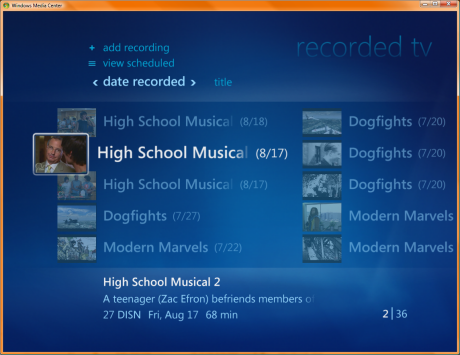
Vista’s Media Center changes all that.  I popped the TV card into a Vista machine.  The OS asked for my cable provider.  Based on my zip code it figured out all the channels I get.  Periodically it goes across the Internet and gets an updated schedule.  At any time it has about ten days worth of scheduling data.  I can scroll through and select something to watch.  If the show isn’t on at the moment, it asks if I want to schedule it to be recorded.  If the show is a series, it asks if I want to record the whole series.  Really cool.

All this is built into Vista’s Media Center and costs nothing extra to use if you have a TV tuner card.

All the recorded content can be viewed from other computers as well.  You do have to watch the hard drive space.  One hour of video takes up about 4 GB of disk space.  You can archive recorded TV on a DVD or CD, but that takes time and planning.

I still don’t watch that much TV, but it is nice to have the convenience of making a digital copy whenever something as big as High School Musical 2 hits the Disney Channel… at least the kids think so.

Posted in edtech, leisure | Tagged , | Comments Off on Vistativo

Pop Quiz

The first day of school is just around the corner.  Here’s a great post about giving a quiz on the first day of class.  I do something similar.  My quiz has 26 matching questions.  On the left are 26 different technologies.  On the right are 26 years starting with 1440, the year Gutenberg invented the printing press.
I give them that first one.  I let them work in groups of two or three to try to figure out the rest.  It gives me enough time to take each student’s picture.  The only way I can learn all the names is by making a cheat sheet with names and pictures.

Half of the technologies on my list were invented after 1980.  Most college freshmen don’t know the CD was invented in 1982.  It has been in the news a few times in the past week, this being the 25th anniversary.   I wonder how many of them caught that bit of news.

I finish by showing a PowerPoint with all the answers and pictures of each technology with the inventor if possible.  It is my first chance to show a proper PowerPoint.  I point out that no bullet points were used.

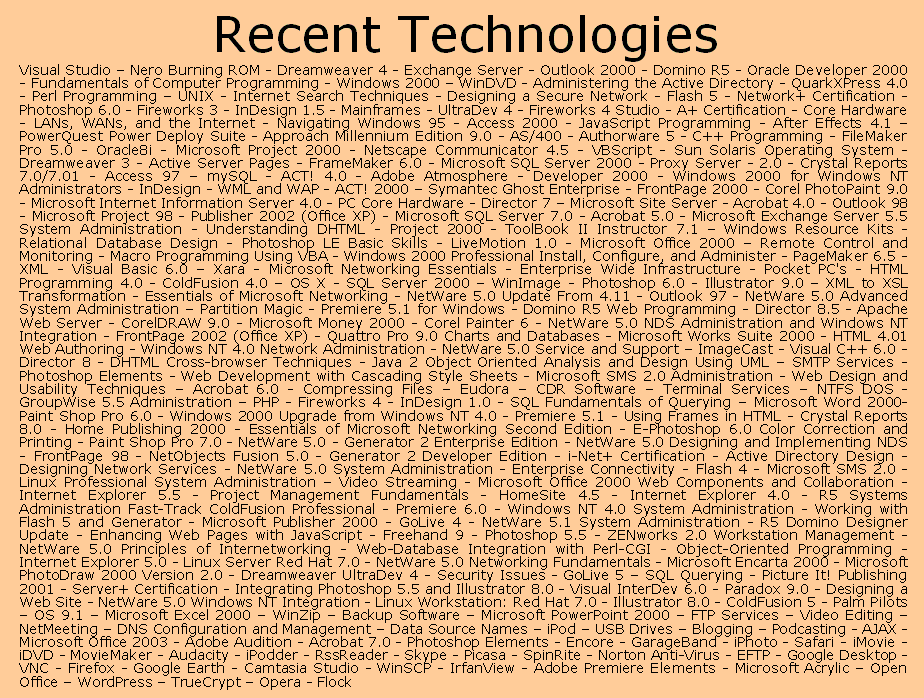
My last slide is my ever-growing list of technologies.

I link it back to ISTE’s NETS for Teachers. One of the standards states that teachers will demonstrate continual growth in technology knowledge and skill to stay abreast of current and emerging technologies. A teacher must have a plan.  At that point, we start on the plan.

Posted in edtech | Tagged , , | 2 Comments

Modern Art

I have been looking through all the pictures from our recent trip.  I have a few with some modern art.  The Indianapolis Art Museum did not permit photography of modern art.  It was all right to shoot anything outside the modern gallery, but I had to put the camera away on the fourth floor.

I suppose there are copyright issues.  Most of the works in the modern gallery were definitely created in the last few years.  My favorite was a room with three parallel orange strings of yarn fastened to the floor in the center of the room and stretched to a window where they were taped.  It looked like a beam of light coming in through the window.

In the corner were about a dozen black strings about eight inches apart stretched in parallel lines from the floor to the ceiling.  Every four strings were aligned in perfectly straight lines if viewed from the right angle.  As the view shifted to the right or the left, the row of strings took on the appearance of a solid plane.

These works weren’t complicated, but they weren’t random either.  I don’t appreciate modern “paint-flingers” as much as other types of artists.  I always wonder… did that turn out exactly like the artist planned?  Was that “splash” intended to be just that size and in that spot or did it just happen.

Take a look at the pictures below.  One of them was done by a world famous artist who is paid thousands of dollars for almost anything he does.  The rest of the pieces were done by first graders taking their first art class.

Can you tell which is which? (Click for a closer look.)

img_1635.JPG

img_1639.JPG

Posted in leisure | Tagged | 1 Comment

Not a good Impression by the help

img_1675.JPG

Today we continued our tour of Indianapolis by visiting the Indianapolis Museum of Art. The piece above is in the front lawn.  This familiar work is by Robert Indiana and has an interesting copyright story.  Indiana failed to copyright his original painting.  Since his art is basically a word, he lost a copyright case because the courts said he could not copyright a word.

As with most art museums, we were most interested in seeing the contents of the Impressionism room.  You may have heard of Monet, Renoir and Degas.  These are all French artists.  One American woman worked with these French men and she became the most famous American Impressionist painter.  Mary Cassatt spent her whole adult life in or around Paris working with mostly French artists.

cassatt.png

Above is a picture I snapped showing a bronze statue by Degas in front of a pastel by Cassatt.

We very nearly didn’t find this work by Cassatt.  It was listed as part of the American Impressionist exhibit.  We went there first.  After two laps around the gallery, we couldn’t find a Cassatt.  We asked the docent in the room for help, but he was more of the “please don’t touch the painting or the wall around the paint” type.  He said he would take a look and he started his way around the huge two-room Impressionist area, reading each name tag as he went.

It is not unusual for Cassatt’s work to be displayed with European artists.  She did live in France for most of her life.  We went to the European section and asked the docent for help.  He took us to the head docent who said he wasn’t sure if the museum had any of Cassatt’s work.  I pointed to her name on the second page of the museum map in the American Impressionist area.  He said he would go over with me and check the area himself.  While this was going on, my wife had decided to try the front information desk.  After the “are you sure we have some of her work” routine, she got the same, “your best bet is the American Impressionist” gallery.

I caught up with the rest of the family as we were all headed back to where we had come from.  I decided to break off from the pack and try a different part of the gallery.  I worked my way to the back of the European Impressionist area and hit pay dirt.  I marked the spot on my map and I headed back to the American Impressionist area to get everyone else.

There were several things that disappointed me with this whole exercise.  How can someone working in rooms filled with famous artwork not take the time to learn what paintings are in the area and what artists painted them?  If I were in one of these rooms for several hours every day I would find out as much about the paintings and painters as possible.  On top of that, why doesn’t IMA have a database of everything they own and where it is hanging?  We were looking for a picture worth several hundred thousand dollars and they did not know where it was.

I don’t like it when people don’t take pride in their work.  Maybe today was an off day at IMA.  I’m willing to give them every benefit of the doubt.  They have a fine museum with many famous and interesting pieces.  I would prefer that they know what they have and where it is.

Posted in leisure | Tagged | 1 Comment

The Children’s Museum

If you have kids between five and ten, put the Children’s Museum in Indianapolis on your list of vacation spots.  If you are familiar with COSI, consider the Children’s Museum similar with more of an “art” emphasis.  There are plenty of hands-on activities… not quite as many as COSI, but plenty.  There are many more static displays.

The center piece is now a Dale Chihuly blown glass piece called Fireworks of Glass.

img_1503.JPG

There are hundreds of individual pieces in this 43-foot tall monstrosity.  It starts in the basement and goes all the way to the roof of the fourth floor.  Since it’s glass, you can get underneath it in the basement and look up through.

img_1487.JPG

There were also hands-on art lessons for the whole family.  Chihuly paints using a “quick” style using his whole body to place the paint.  In the classes we used pastels since paint would not dry quick enough to take home.

img_1655.JPG

Here are our two artists at work.  We plan to have a home exhibit this fall.

Posted in leisure | Tagged | Comments Off on The Children’s Museum