Here are my links for the parent session at Van Buren.
http://www.delicious.com/atrusty/vanburen1to1
Here are my links for the parent session at Van Buren.
http://www.delicious.com/atrusty/vanburen1to1
Not wanting to miss the latest fad in photography, I explored high dynamic range (HDR) this summer. We took our family vacation in the middle of August, so I had a little time to play around with the settings in my camera to capture the best exposures for HDR creation.
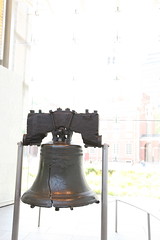
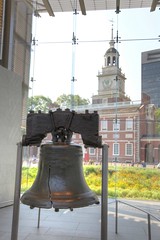
If you are not familiar with HDR, it’s probably best explained with an example. Here is a normally exposed picture of the Liberty Bell.

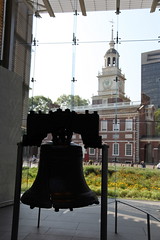
The new home to the Liberty Bell is just across the street from Independence Hall. A window has been fashioned just behind the bell so that as one views the bell, Independence Hall is right there in the background. Most cameras will average the amount of light in the picture and create an image similar to what I have above. Because of the bright light behind the bell, the shutter speed has been reduced to 1/100 of a second. At that quick speed the bell is dark and almost shadow like. Independence Hall is not much better. At 1/100 of a second there is too much light to get a good outline of the tower. It is all white.
To get a good bell picture, the shutter speed needs to be around 1/30 of a second. Independence Hall is going to require a much faster shutter at around 1/400 of a second. HDR is the process of taking all three of these exposures and putting them together in one picture with all the parts exposed correctly.
 |
|
 |
 |
| Over Exposed | Normal Exposure | Under Exposed | HDR – combined exposures from all three pictures |
As you can see from that last picture, the HDR is a combination of all three photos, bringing out the best parts of each picture. If you would like to see higher resolution versions of any of the above pictures, each is linked to the original.
If you have an SLR, there is a good chance your camera has a setting that will do multiple exposures with one press of the button. It is called Auto Exposure Bracketing (AEB). All the Canon SLRs (including my five year old Rebel XT) will do three exposures at different shutter speeds. Some of the Nikons will do up to nine different exposures. I found this chart which shows many models along with the number of frames of AEB.
Many people use a tripod when doing HDR photography. I was on vacation at many locations where a tripod was not practical or permitted. All of my pictures were hand held. That means each one has a little bit of movement. I was able to align the images when I did my HDR processing.
I played around with several programs before deciding Photomatix was the best. It’s used by most of the people I know doing HDR. For me, the killer feature is Batch Processing. I took 1200 HDR photographs during my vacation. Each one consisted of three individual pictures. All I had to do was point Photomatix to the folder with all my photos. Twenty-four hours later, all my HDRs were finished. If I would have done those by hand, I would still be going through my files.
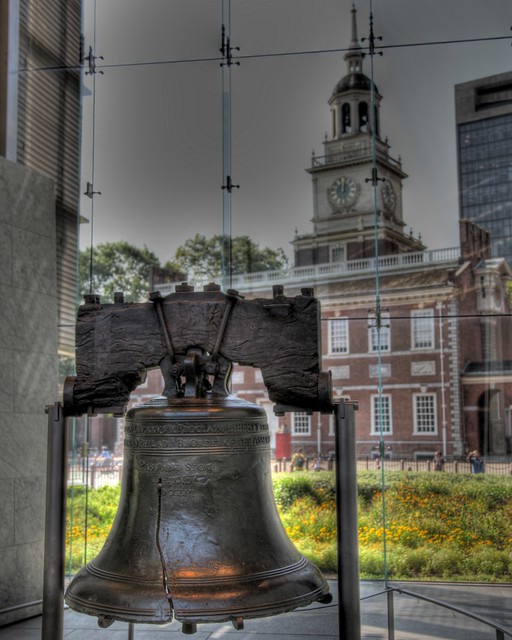
Of course, there are many artistic options when doing HDR processing. It is easy to make a photograph look like a painting. Here is my favorite version of the Liberty Bell cropped as an 8×10.
Creative Commons PowerPoint from Alvin Trusty on Vimeo.
Last month, our ten year old participated in a summer school program which required her to have a digital camera. It had been a few years since we had purchased her $25 "Mickey Mouse" camera (it actually had ears) for our trip to Disneyland. It was time for a real camera, so we picked up a Canon SD1200IS on sale.
 After the workshop ended (and she took some great pictures), I asked everyone if we could have an extended theme-based photo project. I have been listening to a lot of photography podcasts this summer, and one of the main ideas I have heard repeatedly is themed-based shooting. If you shoot random pictures, you never get better at taking pictures. Any photo excursion should have a goal: door knobs, head lights, flowers. The constraint of a theme will force you to frame a good picture when it may be difficult. That will make you a better photographer.
We wanted to do this over the course of a month and started making a list of topics. After the third item, good themes started to get difficult. I offered a more flexible idea. What if the first day we take pictures of things starting with the letter “A”? The second day would be “B” and so on. That would give us 26 days of pictures. We were off and running.
We did come up with some general rules.
1 – Whoever takes a picture of something first “gets” that object. No duplicates.
2 – One point is scored for each picture taken on a given day. If the item has multiple instances of the letter (canned chunk chicken), the points are doubled.
3 – The first two rules were repealed on the third day of the contest when the dad had ten times more points than any one else. We decided a contest was not the best way to learn to shoot good pictures. The best picture of an apple was more valuable than the first picture of an apple.
4 – Nouns and proper nouns are OK. Verbs can only be used with approval of the group. Adjectives are usually not permitted. A dog can be photographed on “D” day, “C” day if she is a Corgi and “T” day if she is named Taffy. She cannot be fluffy on “F” day. On that day, a picture of her fur can be taken.
5 – A picture must be taken of the item on the day its letter is up. On “Q” day we realized no one took a picture of the piano on “P” day. Too late. I was surprised at the number of things we missed every day. We could do this whole thing again taking only pictures of things we missed the first time.
Some letters are much more difficult than others. Today is “U” and there is not a lot of low hanging fruit. We expect “V”, “X”, “Y” and “Z” to be similar.
We are still organizing the pictures so they can be uploaded to Flickr. We will get that done eventually. We have learned that everyone in the house has his/her own archival process and everything is not being reliably backed up. I am setting up a “community” picture deposit area on the server. Everyone will have their own folder and the whole thing will be archived nightly as part of the normal backup routine.
We did use the letters to direct some of our non-picture taking activities. On “M” day we had manicotti. On “P” day we were in Columbus and I (quite easily) talked everyone into eating at P.F.Chang. We used lots of potsticker sauce, drank tea from a pot, and saw the horses on the pedestals outside the restaurant. Later we stopped by Potterybarn and saw some pillows and photo frames. You get the idea.
Next Monday is “Z” day and also a holiday. We are planning a trip to the zoo to photograph a zebra. We’re not sure what will happen on Tuesday. My guess is that we will not stop taking pictures.