Remember This?

My talk from the 2008 eTech Ohio conference was so well received I did it again this year. The content was copyright, but it was also “how to create a great presentation.”  So it was two presentations in one.

I went through the whole thing several times and replaced many of the pictures, re-shooting some of the pictures myself.  I left in a few pictures from last year hoping most people would not notice.

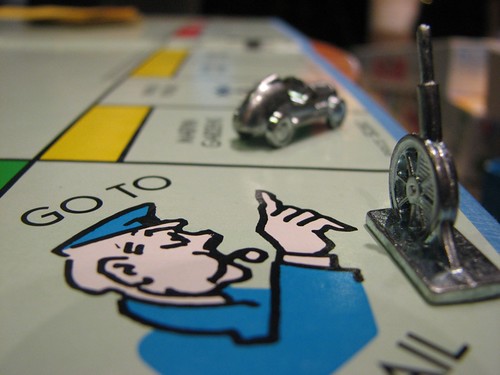
I was going over it before the conference using my Touch just like I did last year.  One of my kids asked to see it.  She went through the whole thing pointing out every picture I had used the year before.  She got to the picture above and I asked the context of the presentation at that point.

“It had something to do with free picture sites online.  If you can’t find free pictures you should go to jail for using copyrighted ones.”

That’s exactly correct.  A year after seeing this presentation, the picture “stuck” with her and she not only recognized it, but remembered why the picture was used.

If I had used a slide with text on it, would the message have stuck?  Probably not.  If all my slides were words, she would have probably gone through it and not noticed the parts that were the same.

One of the keynote speakers at eTech this year was Wesley Fryer.  The one point he made that stuck with me more than any other – the human brain processes pictures 60,000 times faster than text.  It made me think of Nancy Duarte’s point in Slide:ology page 140:

“Presentations are a ‘glance media’ — more closely related to billboards than other media…. Ask yourself whether your message can be processed effectively within three seconds. The audience should be able to quickly ascertain the meaning before turning their attention back to the presenter.”

How many of your slides could someone process in three seconds?  Let’s see… 45 minute presentation at three seconds per slide.  That’s 900 slides!  Sky McCloud does 200 slides in eight minutes.

Posted in edtech | Tagged | 2 Comments

Derivatives – more than Calculus

When it comes to copyright infringement, it helps to be famous.  When artist Shepard Fairey wanted to create a poster during the presidential election, he went to Google.  There he found a picture of Obama, and without seeking permission from the photographer, he used the photo as the source of his artist work.

Under copyright law, this is called a derivative work and creation of such works is under the control of the owner of the original work.  Fairey did not know who owned the photograph he used.  He did not both to check.  He certainly did not have the permission of the work’s owner to create a derivative.

It took a year to determine that the photo was taken by Mannie Garcia, a photographer on assignment for the AP.  Garcia says he photographed Obama for twenty months and saw the poster many times.  He even snapped pictures of the poster.  He says it looked familiar, but he did not realize it was his picture until someone else figured it out.

If Garcia writes a book including famous photos he has taken, will he have to ask Fairey for permission to publish a picture of the poster based on the photo taken by Garcia?

Posted in copyright | Tagged | 6 Comments

Do Not Remix This

Lawrence Lessig has a new book. Remix examines a culture where artists have gotten no more money, businesses have gotten no more profit and 70% of our kids have become copyright criminals. In the video below, Lessig talks about the book on The Colbert Report. Watch the video. Listen as Stephen pleads with the audience NOT to remix the video, especially with a great dance beat.

Of course, the next week, he had to show everyone the remix.

And there are even more if you look on YouTube.

Posted in copyright | Tagged | Comments Off on Do Not Remix This

Yo Yo Ma

I have always wanted to create a post with that subject and I finally have a topic that works.

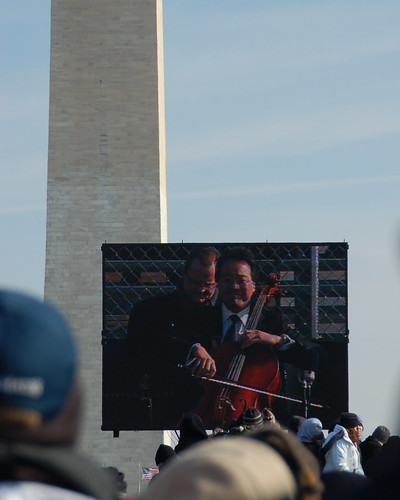
Many of you probably watched the inauguration and heard “Air and Simple Gifts” performed by Yo-Yo Ma (cello), Itzhak Perlman (violin), Anthony McGill (clarinet), and Gabriela Montero (piano).  The piece was composed by John Williams famous for his Darth Vader march.

The piece was commissioned by the Presidential Inaugural Committee.  I think that means John Williams was acting as an agent of the federal government when he composed the work.  Does that make it automatically in the public domain?  Actually this is more complicated.  Williams used another source as inspiration for this work.  One of Obama’s favorite classical composers is Aaron Copland.  Copland’s 1944 ballet “Appalachian Spring” contains the source work, “Simple Gifts” with was written in 1848.  The copyright on the piece from the 1800’s has long expired, but it certainly has not for “Appalachian Spring.”

Here is something else that I find mind-blowing.  Take a look at the Wikipedia entry for Air and Simple Gifts.

http://en.wikipedia.org/wiki/Air_and_Simple_Gifts

The article was created shortly after the piece was performed at the inauguration on Jan. 20.  Within 24 hours of “Air and Simple Gifts” original performance, dozens of people have collaborated to create an informative and well referenced article available to the whole world for free.  When “W” was sworn in as the 43rd President in 2000, Wikipedia had not been invented.  Imagine what the next eight years will bring us.

Posted in copyright | Tagged | 2 Comments

Digital Camera First

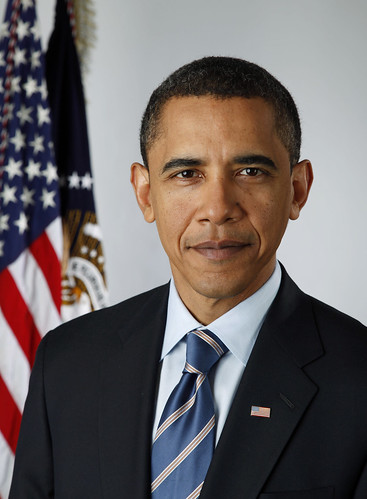
Here is a digital first, and yet another way a digital camera can be used. This picture of Obama was taken with a digital camera and is the first “official portrait” of a president-elect to be taken with a digital camera.

It was taken with a Canon EOS 5D Mark II.  You can see all the settings here.

The picture is credited to Pete Souza, but should automatically be in the public domain because Souza is working for the federal government when taking the picture.


Posted in edtech | Tagged | Comments Off on Digital Camera First