Math and Politics

I have heard about this since I was a kid.  The story as I heard it was that Indiana tried to declare pi equal to three.  It turns out they actually wanted pi to be equal to 3.2.

Wired ran the story last week on the 111 year anniversary of the legislation that (luckily) did not make it to a final vote in the senate after being passed in the house.

House 246 was sent on to the state Senate and was on the verge of passage when everyone’s bacon was serendipitously saved by C.A. Waldo, a Purdue mathematics professor who happened to be in the Statehouse on another matter. Shown the bill and offered an introduction to the genius whose theory it was, Waldo declined, saying he already knew enough crazy people.

If only we could have someone like Waldo around when our federal government tries to create a law involving technology.

Tagged | Comments Off on Math and Politics

EdTechTalk

edtechtalk.pngLast week at the eTech Ohio Conference, I attended John Schinker’s presentation.  He had told me ahead of time that he would be talking about the online community of edtech people that has boosted his overall quality of “edtech life” in the last year.

I found out he has become quite involved with EdTechTalk and is one of the hosts of the EdTechTalkWeekly podcast.  John said I should join for the live chat on Sunday nights at 7pm.  I did that tonight.  It was very worthwhile.   I was able to listen to the live podcast and watch the chat complete with URLs.  The speed round of URLs has something for everyone.  Tonight there was even an interesting guest speaker.

I plan to join them next week.

Posted in edtech | Tagged , , , , | Comments Off on EdTechTalk

twitter

Not wanting to be left out of the rage called “twitter”, I am now setup. 

http://twitter.com/alvintrusty

Tagged | Comments Off on twitter

eTech and Copyright

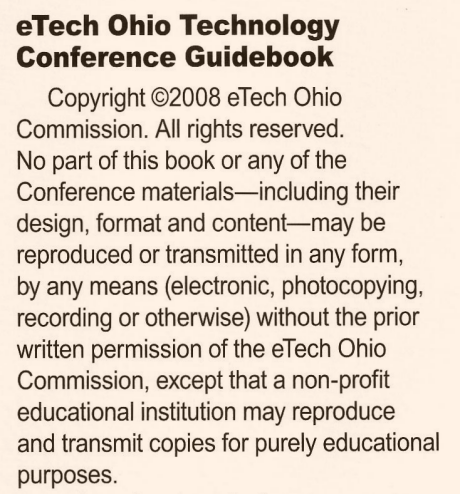
Thanks to my good friend, John, for pointing out this text on page 11 of the eTech Ohio 2008 conference guide book.

etechcopyright.png

Here we have another attempt at making copyright law more than it is.  Copyright law in this country is defined by the United States government and there are clear limitations on any copyright owner’s exclusive rights.  It’s called Fair Use and it not only applies to “purely educational” use, but also:

for purposes such as criticism, comment, news reporting, teaching (including multiple copies for classroom use), scholarship, or research

So I may use an except of a copyright protected work without permission (as I have with the electronically scanned insert above) to make comments (as I am now) about that copyright protected work.

A copyright owner cannot redefine copyright law by stating extra limitations in a book, audio or video recording.  Here is a great story chronicling the efforts of the NFL to takedown a video posted by Wendy Seltzer.  Wendy recorded the disclaimer by the NFL where they state:

This telecast is copyrighted by the NFL for the private use of our audience, and any other use of this telecast or of any pictures, descriptions or accounts of the game without the NFL’s consent is prohibited

Wendy then posted the video on YouTube so she could have a discussion with her online class (fair use – teaching).  The NFL tried to have the video taken offline, but failed to do so.

More than anything else, I wish the copyright notice in eTech’s material could promote something like CreativeCommons.  This would make it much easier for educators to use the work without worrying about breaking the law (I am uncertain of the exact meaning of “purely educational purposes”) and commercial use could be restricted with a CC-noncommercial license.

Posted in copyright, edtech | Tagged , , , | 2 Comments

Why so many slides?

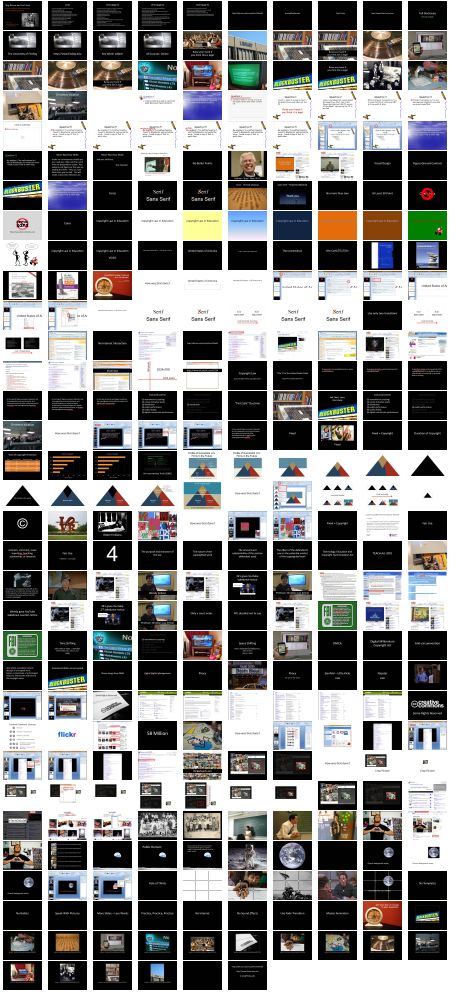
Here are my slides from my eTech talk.
begborrow.jpg

You see 326 thumbnails, but one slide was blank.  I displayed the blank while I explained a new section.  That leaves 325 slides with content.  Some of those slides have multiple animations triggered by a mouse click and so the presentation appears to have even more slides.

Why so many?  I want a consistent message during my presentation.  I don’t show a slide that takes more than a few seconds to explain.  During practice I can get each slide down to a few very specific words.  This makes my total presentation time much more consistent which is important at a conference or during a classroom presentation.

Think of each slide as a cue for your message.  The more cues you have, the less likely you are to leave something out.  The longer you loiter on each slide, the higher the probability of leaving a minor point out of the monologue.  You also have a greater chance of having your delivery time fluctuate.

Some topics require more slides.  I don’t leave PowerPoint to demonstrate an external program.  Instead I do screen captures of the external program and put them into the presentation.  To give the “look and feel” of using that external program, many slides may be required.  The bonus during the presentation is that the overall timing won’t be effected by a program that takes a while to start or function properly.

I had over 100 screen shots that I incorporated in my eTech talk.  I blazed through those very fast.  I also didn’t leave PowerPoint to show items on the Internet.  I captured those web pages as well.  During a presentation (especially at a conference), you never know if the Internet is going to work, or if the bandwidth is going to be adequate.  Doing the captures ahead of time will keep the delivery time under control.

Take a look at my Google Search Tips presentation.  It’s about eight minutes and has 38 slides.  That’s a pace of a little more than 200 slides an hour.  That’s actually a nice relaxed pace.

When I have my freshmen do their final presentations, each is limited to three to five minutes.  I have a sample presentation that I give.  It’s 52 slides and takes four minutes.  I can do the presentation ten times and every time be at 4 minutes plus or minus ten seconds.  More importantly, everyone remembers the content.

You should play around with different numbers of slides to figure out your own pace.  Split the complicated material into several simple slides.  In the end, your presentation will be better and easier to deliver.

Posted in copyright, edtech | Tagged , , | Comments Off on Why so many slides?