free-reading.net

If you are an elementary school literacy teacher, the free-reading.net is a wiki you should see.
freereading.gif

Here is what this site is all about:

Free-Reading is an ongoing, collaborative, teacher-based, curriculum-sharing experiment. We’re looking to provide a reliable forum where teachers can openly and freely share their successful and effective methods for teaching reading in grades K-1.
Our premises are:

  • The research on how students learn to read is well-established.
  • The research on which instructional techniques work is well-understood.
  • The voices of those who know what works best — the classroom teachers — are rarely heard in instructional design.
  • The power of “we” is far greater than the power of “you” or “I.”

Resources like this are only possible because great teachers create great resources and then share them. If you have something you can add, it will only make this resource better.

Posted in edtech | Tagged , , , , | 6 Comments

Lessig at TED


http://www.ted.com/index.php/talks/view/id/187

Here is my favorite copyright reform advocate. Lawrence Lessig is a law professor at Stanford. He is also the founder of Creative Commons and a board member of the EFF.

Posted in copyright | Tagged , , | 1 Comment

National Repository of Online Courses – NROC

One of the greatest resources that I am taking away from this conference is the National Repository of Online Courses (NROC).  This online library of courses is absolutely free to use by anyone, student, teacher, higher education faculty, home schooler… anyone.

Currently, the repository has fourteen Advanced Placement courses, fourteen College Course Foundations courses and four High School Course Foundations courses.  These are complete courses with a syllabus, outline, list of supplemental materials and a complete set of multimedia lessons.  The lessons are highly developed with periodic interaction.  Take a look at the first AP Physics lesson.

Much of the funding for this program comes from the Hewlett Foundation.  I talked with Gary Lopez, one of the presenters, and he explained that any school or student can link directly to any of the courses or content for free and use it in any way.  If your school becomes a member, you can get copies of all the materials to use (even modify) in any way you want.  I asked how my school could become a member and Gary explained that we really can’t.  Am I losing you?

Only large agencies can become members.  A single school in Ohio would not become a member.  Instead the Ohio Department of Education would become a member.  At that point, all the schools in Ohio would get all the membership benefits.  I asked Gary if I should approach someone from ODE to initiate our membership, and he explained that we should just use the NROC content.  NROC monitors all access to the content and when a state has a certain number of schools using the content, they contact the state department of education and encourage them to become members.

You will have a hard time finding better online course content with fewer strings attached.  Please use this free content!

Posted in edtech | Tagged , , , , , | 2 Comments

Games and Sims

Today I attended a session on the role of games and sims in online learning.  The first couple of minutes of the talk were devoted to overcoming the stigma that may be associated with games in the classroom.  Some parents and administrators still think education should be difficult and boring.  Playing a game sounds like something that goes on during recess.
The simplest solution was to call the activities simulations.  No one seems to have a problem with that term.

The presenter went through many years of sim development starting with activities that were really nothing more than an interactive “reading” assignment.  Each activity was categorized using Bloom’s Taxonomy.  The presenter explained that five years ago, they were learning to create the sims and using the fundamental functions of the environment.  This resulted in simple knowledge and comprehension sims that were the technical equivalent of a lecture.

The goal was to create simulations where the students decide the path of learning.  The environment would change based on decisions made by the students during the simulation.  In the examples, the presenter showed games that do not have a predetermined ending.  The students must solve problems or create the circumstances required to complete the activity.

It is important to note that these sims are created by a team of people with very different backgrounds.  Some are education experts while others are programmers or artists.  The team effort results in the educationally sound, interactive environments of these games.

Posted in edtech | Tagged , , , , | Comments Off on Games and Sims

Web 2.0pians

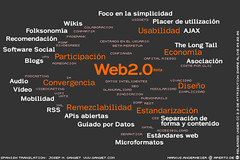
It was a long, great day.  I just came in from the VSS networking dinner at the Mohammed Ali Center.  I sat down to catch up with my online activities and the first item in my feed is something from Gary Stager.  In the final paragraph he uses the term Web 2.0pians and I cannot think of a more accurate term to describe some of the things I saw today.

The first session I went to focused on Second Life (I know… it won’t die) in the virtual school environment.  The room was packed with web-two-point-opians that all wanted to replace whatever they were currently doing with some sort of Second Life environment.  We took a tour of an Egyptian Pyramid led by a person actually in California.  It went pretty well until someone in a gargoyle suite tried to talk to our avatar.  We moved on to a new web 2.0 technology before things got out of hand.

More than anything I was disappointed by the number of people that simply said “web 2.0” without offering a good educational situation or example showing how the technology could improve learning.  I actually heard someone say they would hype their online school with an event using Google Earth.

Hey everyone.  Our school uses Google Earth.  It’s a cool web 2.0 technology.  Need we say more?

Posted in edtech | Tagged , , , , , | Comments Off on Web 2.0pians