Yesterday this post was in Slashdot. Should schools block access to Wikipedia?
I have blogged about wikis before. I only mentioned Wikipedia as an example of a wiki and didn’t elaborate on the content found there. It turns out I use Wikipedia often. Just last night after we watched a movie about Pocahontas, we went to Wikipedia to find out more information about the main character of the movie.
If you gain anything from the Nature article, it should be that Britannica had 123 factual errors. No one is talking about blocking Britannica because of this.
Wikipedia does suffer from “politically” motivated smearing. If someone is running for office, an opponent can easily add incorrect “historical” information to a biographical entry. You don’t have to be in politics to have something like this happen to your entry in Wikipedia. Adam Curry was accused of changing the Wikipedia entry about podcasting to give himself most of the credit for creating the phenomenon.
A Wikipedia article concerning Pocahontas, a person that lived 400 years ago, is probably safe from personal or politically motivated modifications. If you are concerned about accuracy in content, Wikipedia gives authors the ability to site resources of factual information.
I normally use Wikipedia for technical information. When I wanted a good resource explaining TCP/IP, Wikipedia was perfect. The external links found at the bottom of each article are often as valuable as the article itself. The Wikipedia article about YouTube has a link that compares more than twenty video services. I haven’t found a video comparison resource like the Wikipedia article any where else.
The best known comparison of Wikipedia content to a published encyclopedia is the Nature (paid subscription required) article published in December, 2005. This article said that Wikipedia was almost as good (BBC News, MSNBC) as Britannica when comparing articles about science.
Experts were given 42 articles of unknown publication. Eight “serious errors” were found – four from Britannica and four from Wikipedia. Overall, there were 123 factual errors in Britannica and 162 in Wikipedia.
Britannica immediately claimed the article was flawed and demanded the article be retracted. Nature stood behind the article and the research used to create it and never retracted the articled.
If you gain anything from the Nature article, it should be that Britannica had 123 factual errors. No one is talking about blocking Britannica because of this.
Blocking a site like Wikipedia undermines one of the most important lessons our students need to learn about information; with the almost unlimited volume of information we have, there is value in distinguishing accurate from inaccurate. This is a critical proficiency of the lifelong learner.
The days of reading something and automatically validating it as authentic are gone. If Britannica has 123 factual errors, can we count on any one resource? That should be the point teachers are emphasizing to students.
 Today Netvibes announced a new feature of their “start” page. Starting in about six weeks users can create pages and “share” them with the public. This isn’t anything new for “start pages” in general. Protopage and Pageflakes will already let you do this.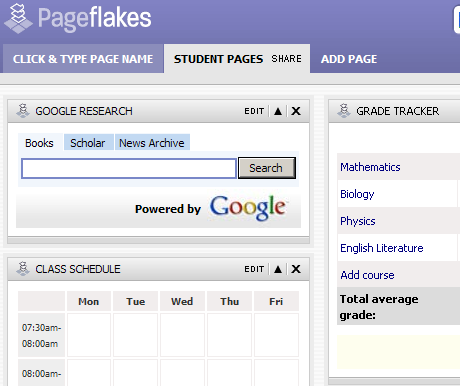
 Would you give a first grader $2000 to spend on decorating a bedroom? Neither would I. But I did spend $9 for a