
Here is the newest member of the family. Taffy is a Corgi. She spends her days herding the neighborhood kids around the yard. The rest of the time she is sacked out on the floor. You can reach her at taffy@trustyetc.com.




Here is the newest member of the family. Taffy is a Corgi. She spends her days herding the neighborhood kids around the yard. The rest of the time she is sacked out on the floor. You can reach her at taffy@trustyetc.com.
Take a look at the Federal Election Commission‘s web site.
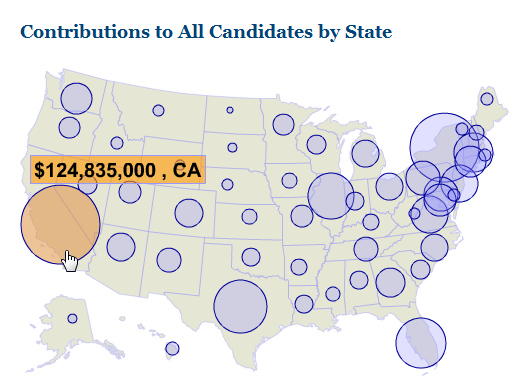
That’s 124 million dollars from the state of California. Add all the states together and more than ONE BILLION DOLLARS has been donated and spent on the 2008 Presidential Election. The job pays $400,000 per year plus a few fringe benefits (a spacious home, a few bullet-proof cars and a couple of 747 jets).
Those fringe benefits might add up to several times the salary, but we are still talking about a lopsided cost for a job. The cost-benefit ratio is something like 500 to 1. And spending this money only gives you four years of the salary. If you want the job a second time, you have to spend just as much during the re-election campaign.
You won’t hear a story about this on the news. Where do you think 99% of this money is spent? The media isn’t about to bite the hand that gives them the handout.
Is there any question as to why the average person doesn’t trust the government?
Here is something else I don’t understand. The president sends a three page document to Congress. Those three pages are incorporated into a 110 page law which fails to pass the House. The Senate then takes that document, adds 341 pages making the total a behemoth 451 pages. This is passed by both houses and sent back to the President where he signs it into law. Who gets credit for this law? The President’s contribution now weighs in at less than 1% of the final document.
If your work is 1% of a group project in one of my classes, you aren’t getting many points from the final grade.
I have been a big fan of Flickrleech for more than a year. The site uses the Flickr API to search photos on the Flickr site. The draw is the interface. Instead of showing ten pictures per page, Flickrleech shows 200. It makes scanning for a picture much quicker.

Now Flickrleech has added the ability to isolate only picture licensed as Creative Commons. The feature isn’t obvious on the main page, but once you find it, it’s easy to use.
Do a normal search and then click the advanced search link. This will open a window with a list of options. Licenses are at the bottom.
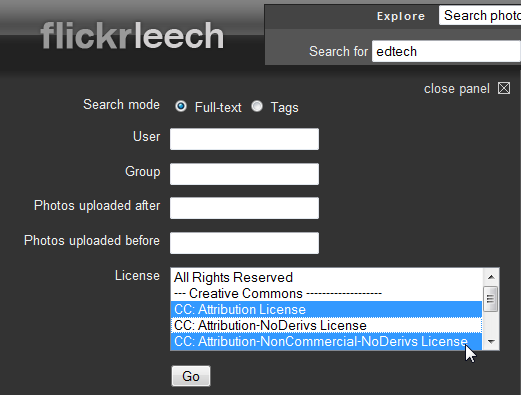
There are six different Creative Commons licenses offered on Flickr. If you would like to select more than one, hold down the CTRL key while making the selects.
After the search is complete, clicking any photo listed will open that photo on the official Flickr site. That makes it easy to grab attribution credentials and other information. The best Flickr search tool just got better.
Today eSchool News published an article about the nation’s first tech-literacy exam. In four years, the Nation’s Report Card will include technological literacy of students. This means schools will be forced to assess student technology competencies. If it is being assessed, it has to be taught. I predict a jump in the number of technical courses offered in schools.
 Unfortunately, I don’t think this is the answer. We need technology that is used in the context of every subject, not technology for technology’s sake. Take a look at the National Educational Technology Standards for Students (NETS-S)
Here are the main categories:
Creativity and Innovation
Communication and Collaboration
Research and Information Fluency
Critical Thinking, Problem Solving, and Decision Making
Digital Citizenship
Technology Operations and Concepts
Only the last one (and it’s at the bottom for a reason) easily fits into a technology course. All the others beg to be integrated into non-technical courses. For the first time, teachers may be forced to incorporate technology into the curriculum. This will certainly fail if teachers are not prepared to take on this task. Read the NETS for Teachers standards.
Technology Operations and Concepts (last on the student list) did not even make the teacher list. This is because teachers are supposed to be technology literate. Look at some of the items in these standards:
1a. promote, support, and model creative and innovative thinking and inventiveness
1b. engage students in exploring real-world issues and solving authentic problems using digital tools and resources
3b. collaborate with students, peers, parents, and community members using digital tools and resources to support student success and innovation
Here is a good question for an educator. “What digital tools are you using to collaborate with students, peers, parents and community members?”
Very few teachers have arrived in the “web 2.0” world. I continually introduce teachers to sites like Delicious even though it has been one of my main digital tools for more than three years. Few teachers use blogs, social networks, wikis or podcasts. In fact, many teachers don’t know what all these things are.
When our students are tested for technology literacy, things will have to change. It is an exciting time to be a teacher.

I needed a picture to explain this to one of the kids, and Excel worked out perfect. Can you see that one piece of the pizza on the left is the same amount as two pieces from the pizza on the right? 1/4 does equal 2/8.
These are pie charts in Excel. It took less than a minute to make the two charts. Can you duplicate them?