Troubleshooting

I have had three “real-world” problems presented to me this week that are a good representation of problems present in the day-to-day life of a technical consultant.  I work with several schools as a consultant and  I end up getting a few troubleshooting calls.  This week I had two that looked identical but were completely unrelated.

On Monday one of the administrative computers could not get email.  On Tuesday another computer couldn’t get email either.  There was one main difference; the “Tuesday” computer could not get to any web pages while the “Monday” computer could get to most places on the web.

It turned out that the first computer had an erroneous DNS setting and the second computer had lost its connection to the DHCP server.  Both of these problems are fairly simple to troubleshoot,  but required a solid understanding of basic computer networking.

As I handled the second problem, which on the surface looked exactly like the first problem, I thought about the “multiple choice options” available to me to fix the problem.  No one was dangling a list of “answers” in front of me in the standard NCLB form.

On Wednesday I was asked to solve a completely different problem.  A group of people needed a way of sharing documents online, but the documents must not be available to people outside the group.  This was a problem with many possible solutions, but I wasn’t given a list of possible answers.

None of these problems took long to solve.  Each one required a basic knowledge of the systems involved.  Formulating the answers required what I consider to be typical problem solving skills not assessable by a multiple choice test.
Posted in edtech | Tagged , , | Comments Off on Troubleshooting

Kevin O’Malley: author, artist, all around nice guy

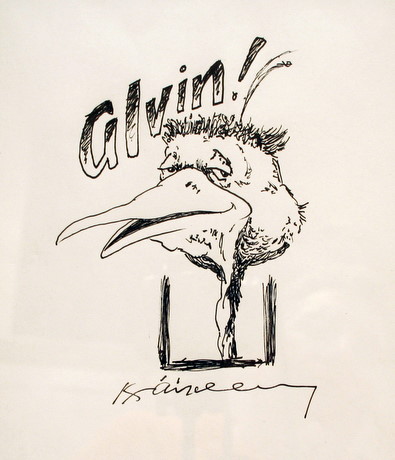
I had the good fortune of running into Kevin O’Malley at a conference.  We happened to be standing at the same table.  I saw him doodling on a sheet of paper and struck up a conversation.  I found out he was a children’s book author and that he had recently been to the Mazza.  He was drawing what looked like an ostrich.  He asked my name and said he would look me up the next time he was in Findlay.

kevinomalley.JPG

A little while later he stopped by the table again and gave me the ostrich picture, autographed and customized with my name at the top.  Cool.

Everyone in my group loved it and lined up asking for an autograph.  He doesn’t do autographs.  Instead, he drew a picture, put the name of the recipient at the top and signed the bottom.  I don’t know which was more amazing, the fact that he did a custom picture for every person that asked for one or that he could crank one out in less than a minute.

If you have an elementary child and are looking for a great picture book, get a copy of Once Upon a Cool Motorcycle Dude.  It’s a clever and funny story about a boy and a girl that write a story together.  The girl wants it to be about a princess while the boy wants it to be able a cool motorcycle dude.  The combination makes a great story.

Watch the conference circuit for Kevin’s name.  If he is in your area, it will be worth the trip to see him.

Tagged | 1 Comment

Curriculum Based on Critical Thinking

Linda Darling-Hammond of Stanford University has an opinion article in the Oct 14, San Francisco Chronicle.  It explains how other countries are testing students’ 21st century skills and how NCLB is not helping to prepare our students for the knowledge economy that creates our high standard of living.
The focus of the opinion piece is testing.  Our tests in the United States are usually multiple choice.  Other countries use an assortment of questions that focus on critical thinking skills.  Here is a paragraph from the paper.

In the United States, a typical item on the 12th grade National Assessment of Educational Progress, for example, asks students which two elements from a multiple choice list are found in the Earth’s atmosphere. An item from the Victoria, Australia, high school biology test (which resembles those in Hong Kong and Singapore) describes how a particular virus works, asks students to design a drug to kill the virus and explain how the drug operates (complete with diagrams), and then to design and describe an experiment to test the drug – asking students to think and act like scientists.

Critical thinking skills are definitely harder to assess.  It takes a long time to grade a test with open ended questions that can have many different paths to a correct answer.

I had to take three calculus courses in college.  I took the first two from the same professor who focused on real-world applications of mathematical principles.  The questions on the tests always looked completely different than the ones in the book.  I learned that I couldn’t memorize all the homework and then do well on the tests.  I had to understand the concepts. I learned to understand how calculus could be used as a tool to solve real problems.

When it came time for the third calculus course, the section offered by the “real-world professor” was at the same time as one of my major courses so I had to register for another section taught by the “multiple choice mathematician”.  That’s right.  All the tests were multiple choice.  While I can remember many questions verbatim from the first two courses, I cannot remember a single concept from the third class.

I’m sure the tests in that third course were a lot easier to grade, but that didn’t help me when it came time to use those principles in my upper-level science courses.

Changing our curriculum to focus on critical thinking and problem solving skills will not be easy.   Our standard of living depends on this change.  Our students must be able to function in the real world which is not multiple choice.

Tagged , | 1 Comment

Colr

colr.pngLooking for a color scheme based on the pictures in your project?  Colr.org can help.

Upload your picture to Flickr.  Then go to the Colr site and copy the URL of your picture into the color schedule creator.  Mouse-over the picture and select the colors for your new scheme.  When you are finished, tag your scheme and the site will remember it.

If you don’t have a picture in Flickr, you can select “random” and Colr will find a picture for you.  If want to use the color scheme of a specific web site, there is an option to enter a URL.  Colr uses the CSS color information to create a swatch with the site colors.

It’s an all around handy color tool.

Tagged , | Comments Off on Colr

Microsoft Matters Less???

Christopher Dawson has an educational technology management blog on the ZDNet site.  In today’s post, he talks about how Microsoft is becoming less important as an operating system vendor.  Christopher is using Ubuntu in the lab in his school with great success and student interest.

There is absolutely nothing wrong with using Ubuntu, OS X or anything other non-Windows OS in a school.  Students should be given as much exposure to as many different technology tools as possible.  But to place any other operating system on the same level as Microsoft’s OS just isn’t right.  Here are yesterday’s stats from w3counter

Operating Systems
1 Windows XP 81.02%
2 Mac OS X 4.46%
3 Windows Vista 4.14%
4 Windows 2000 3.81%
5 Linux 1.70%
6 Windows 98 1.27%
7 Windows 2003 0.74%
8 Windows ME 0.44%
9 Windows NT 0.06%
10 Mac PowerPC 0.03%

I’m not sure why OS X isn’t broken down into the various versions (Cheetah, Jaguar, Panther, etc).  Given the fact that all distributions of Linux put together have just edged out Windows 98, there probably isn’t a single distro that would be much more than a blip on the radar.

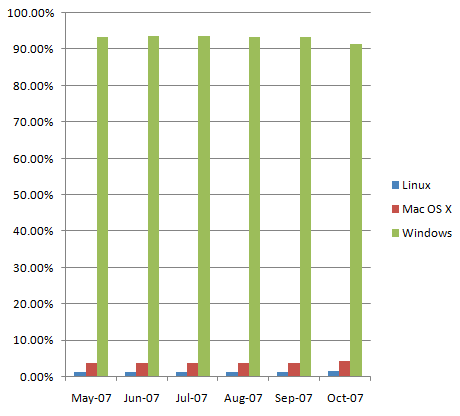
If you put all the versions of Window together and look at all the data available on w3counter’s site, you get a chart like this:

oschart.gif

At its current rate of decline, Microsoft will matter a lot less in about twenty years.  There was one jump in the data that I plan to watch.  OS X went from 3.79% on Oct 10, to 4.46% on Oct 20.  I am interested in seeing where OS X is at the end of the month.

I think all the OS talk is wasted wind.  We should focus on teaching our students how to learn something new quickly and to manage information within any environment.  In twenty years those skills will matter.

Posted in edtech | Tagged , , | 1 Comment